Showing posts with label on. Show all posts

Wednesday, November 16, 2016

I Know What You Did on the Web

This graphic from Baynote Shows a summary of what common online companies like Facebook and Google are doing with your data. This would make a great discussion board topic relating to Big Data for CS Principles.

Read More..

Sunday, August 7, 2016

Invitation to connect on LinkedIn

 
LinkedIn


From Rebecca Dovi
 
President at CSTA - Central VA
Richmond, Virginia Area


Id like to add you to my professional network on LinkedIn.

- Rebecca


Confirm that you know Rebecca


You are receiving Invitation to Connect emails. Unsubscribe
© 2012, LinkedIn Corporation. 2029 Stierlin Ct. Mountain View, CA 94043, USA


OK - this is really cracking me up. I accidentally hit THAT button in LinkedIn a few weeks back. Many of you know this since you have suffered the spam it has generated. Apparently it also asked my blog to join my network.

To be honest I am not sure what LinkedIn does besides spam a lot of very nice people. A lot. Sorry if you were one of them. Please feel free to explain it to me, school is about to start and my brain is on overload and I could be missing something amazing.

Reason number 15 why neglecting your blog for three weeks is a bad idea...it starts joining social networks due to loneliness.
Read More..

Sunday, July 24, 2016

Apple dominate market Samsung is on two


According the latest study IDC , Apple returned at  share 68% of global market of tablette in the second quarter of 2012 .Samsung is the second ,exceeding Amazon , and on place four is Asus . The top is completed of Acer .


Apple managed on second quarter to sell 17 million of tablette iPad at worldwide . Samsung , with all versions of Galaxy Tab ,sold only 2,4 million units , while Amazon , which has in portfolio only Kindle Fire with screen of 7 inch about 1,25 million. Asus exceeded 855.000 of units sold , and Acer only 385.000 . IDC does not give figures for other manufacturers .

Company analysis estimated sales of tablette at 25 of million units . Growth is of 66,4% comparative with second quarter of 2011
http://blog-de-filme-online.blogspot.ro
Read More..

Friday, May 6, 2016

Preventing Bing Page Popping on Windows 8

Preventing Bing page popping up every time you connect Internet on Windows 8 


As Microsofts new Operating System started rolling out, everyone out there wanted a copy of it as soon as possible.  For that regard, Microsoft did very well delivering its new product via its various channels, most popular of it being Online purchase download option.

With its new operating system hitting most number of computers to date, people started having some strange issues that they never had with their old operating systems.

One of the troublesome issue with Windows 8 is that whenever you get connected to internet on Windows 8, sometimes a Internet Explorer or your default browser launches automatically with Microsofts Bing page.  Some people find it useful as they dont need to launch their browsers automatically, but few are getting this annoying as if your Internet interrupts for a minute and then restores back, the popup comes up again giving you a headache.


The link which it opens:

http://go.microsoft.com/fwlink/?LinkID=219472&clcid=0x409

Which redirects to Bing.com

In the post, we will be following a simple method of fixing this issue.  With a simple registry entry modification, we can overcome this problem.

Heres how to fix it:

Open Registry Editor by opening Run Command by pressing Window + R key and type regedit.

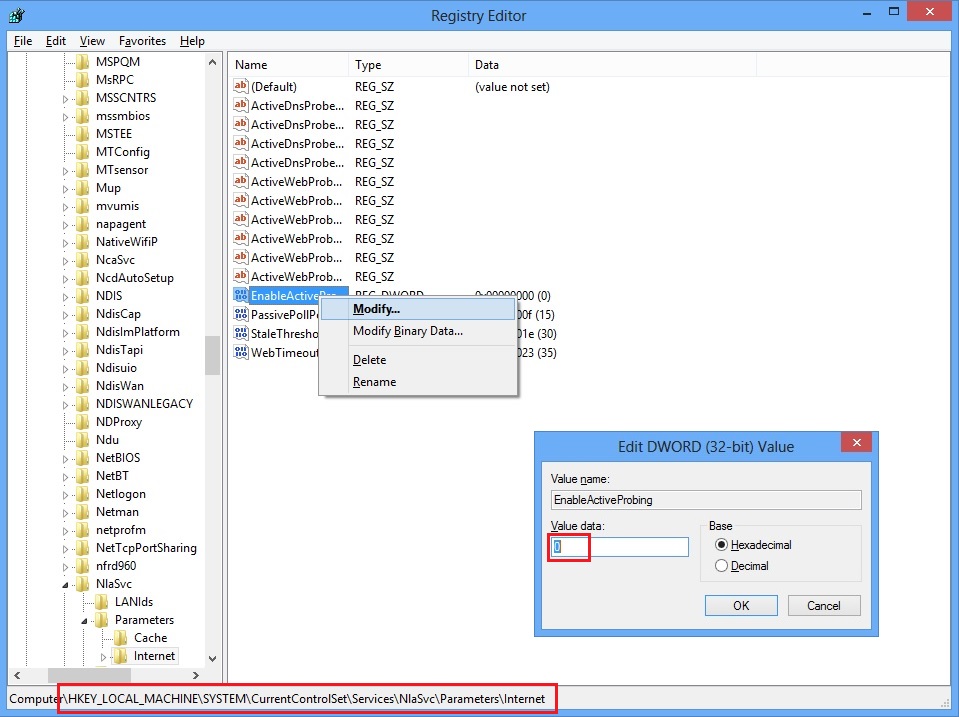
From left folder view panel, navigate to the following registry key shown in below image.


Right click EnableActiveProb.. and click Modify...

In Edit Box, just make sure your Value data: contains 0, not 1.  If it is 1, change it to 0, click Ok and Restart your computer.

You will not get that Bing start page every time you will connect to your Internet on Windows 8.


Enjoy..
Comments welcome...
Read More..

Saturday, July 19, 2014

Java Security Interview Questions and Answers Single Sign On i e SSO with Spring 3 Security


Q. Can you provide a high level overview of the "access control security" in a recent application you had worked?
A. As shown below, SiteMinder is configured to intercept the calls to authenticate the user. Once the user is authenticated, a HTTP header "SM_USER" is added with the authenticated user name. For example "123". The user header is passed to Spring 3 security. The "Security.jar" is a custom component that knows how to retrieve user roles for a given user like 123 from a database or LDAP server. This custom component is responsible for creating a UserDetails Spring object that contains the roles as authorities. Once you have the authorities or roles for a given user, you can restrict your application URLs and functions to provide proper access control.


Q. What is SSO (i.e. Single Sign-ON)?
A. Single sign-on (SSO) is a session/user authentication process that permits a user to enter one name and password in order to access multiple applications. The process authenticates the user for all the applications they have been given rights to and eliminates further prompts when they switch applications during a particular session. For example, SiteMinder, TivoliAccessManager (i.e. TAM), etc provides SSO. As shown in the diagram above SiteMinder authenticates the user and adds the SM_USER HTTP header to the application. It removes all the "SM" headers and add them after authenticating the user. This prevents amy malicious headers being injected via the browser with plugins like "Firefox Modify headers".


Q. How will you go about implementing authentication and authorization in a web application?
A. Use SSO application like SIteminder or Tivoli Access Manager to authenticate users, and Spring security 3 for authorization as described in the following Spring 3 security tutorials. Spring security pre-authentication scenario assumes that a valid authenticated user is available via  either Single Sign On (SSO) applications like Siteminder, Tivoli, etc or a X509 certification based authentication. The Spring security in this scenario will only be used for authorization. The links to the tutorials below demonstrates this with code.


Q. Can you describe your understanding of SSL, key stores, and trust stores?
A.  SSL, key stores and trust stores


Q. What tools do you use to test your application for security holes?
A. These tests are known as PEN (i.e. penetration) testing or security vulnerability testing. There are tools like
  • SkipFish (web application security scanner) from Google.
  • Tamper data from Firefox. 

Q. What is a two factor authentication?
A. Two-factor authentication is a security process in which the user provides two means of identification. This includes
  • something you have and something you know. For example, a bank card is which something you have and a PIN (i.e. Personal Identification Number) is something you know.
  • two forms of identification like password and a biometric data like finger print or voice print. Some security procedures now require three-factor authentication, which involves possession of a physical token and a password, used in conjunction with biometric data. 
Q. What are the different layers of security?
A.

Application-Layer Security: For example, Spring 3 Security, JAAS (Java Authentication and Authorization) that provides a set of APIs to provide authentication and authorization (aka access control), etc. JAAS provides pluggable and extendable  framework for programmatic user authentication and authorization at the JSE level (NOT JEE level). JAAS provides security at the JVM level (e.g. classes, resources). JAAS is the the core underlying technology for JEE Security. Spring security tackles security at the JEE level (e.g. URLs, Controller methods, service methods, etc)

Transport-Layer Security: Java Secure Sockets Extension (JSSE) provides a framework and an implementation for a Java version of the Secure Sockets Layer (SSL) and Transport Layer Security (TLS) protocols and includes functionality for data encryption, server authentication, message integrity, and optional client authentication to enable secure Internet communications. (TLS) 1.0 / (SSL) 3.0, is the mechanism to provide private, secured and reliable communication over the internet between the client and the server. It is the most widely used protocol that provides HTTPS for internet communications between the client (web browsers) and web servers.

Message-Layer Security: In message-layer security, security information is contained within the SOAP message and/or SOAP message attachment, which allows security information to travel along with the message or attachment. For example, the credit card number is signed by a sender and encrypted for a particular receiver to decrypt. Java Generic Security Services (Java GSS-API) is a token-based API used to securely exchange messages between communicating applications. The GSS-API offers application programmers uniform access to security services on top of a variety of underlying security mechanisms, including Kerberos. The advantage of this over point to point transport layer security is that the security stays with the message over all hops and after the message arrives at its destination. So, it can be used with intermidiaries over multiple hops and protocols (e.g. HTTP, JMS, etc). The major disadvantage is that it is more complex to implement and requires more processing.

Note: Simple Authentication and Security Layer (SASL) is a framework for authentication and data security in Internet protocols.  SASL is an Application-Layer security that supports TLS to compliment the services offered SASL.

Note: The Java security API is complicated and Spring security as demonstrated via the above tutorials might be a better alternative.

    Read More..

    Friday, July 11, 2014

    Two Good Articles on Whats new in AutoCAD 2013 from Cadalyst Magazine

    Cadalyst Magazine has posted two great articles discussing whats new in AutoCAD 2013.

    One is "AutoCAD 2013 from the CAD Manager’s Chair" by CAD Manager Robert Green.

    The other is from Cadalyst Labs Reviews "AutoCAD 2013" by Bill Fane.

    Robert Green gives a good review of the new version of AutoCAD from the perspective of a CAD Manager.  He highlights the main issues a manager needs to be aware of.

    Bill Fane details out the new features, updates, and changes to AutoCAD 2013.

    Check them out.  They are good articles.
    Read More..

    Tuesday, May 20, 2014

    openSUSE 12 2 on a Samsung R510 almost perfect out of the box!


    Had the brightness function buttons worked...but the solution is very simple.

    Just  add acpi_backlight=vendor to the boot loader and the brightness buttons will now work as intended, controlling the backlight.

    This will also apply to other Samsung Netbooks/Laptops.

    On the subject of openSUSE 12.2, I have to say it is a very nice release.

    Everything seems to be working, it is fast and nippy!

    The two months of extra stabilisation have really paid off, I find it annoying when a distribution that has an emphasis on stability such as openSUSE or Ubuntu is released in a too much of a buggy state.

    But we must meet the release schedule....

    In the case of a community project, is meeting the release schedule more important than providing users with a better experience?

    I think we can safely say no, and if the release schedule has to be delayed in order to provide users with a better experience it should be done without question.

    Putting the users first is what makes a true community project, so well done openSUSE.

    You fulfilled one of your guiding principles, to make users happy.


    One comparison I always make when using a Linux distribution is how speedy / responsive it feels when compared to Windows 7, with concern to openSUSE 12.2 I am having a hard time deciding.

    Thats a good thing if you ask me.

    I dont expect the battery time to be better as some Windows drivers have better power management features, such as the Intel display driver which allows you to adjust the power setting (High performance / lower power consumption) and create a profile when using the battery / mains power.

    I have yet to poke around in the Intel Linux driver / kernel module, maybe an equivalent setting is there.

    I noticed KDE no longer provides a battery time estimate, a decision made by the KDE team. See here for further information - https://bugs.kde.org/show_bug.cgi?id=304510

    Essentially it was too inaccurate, which I would have to agree with. Even Windows is inaccurate for that matter.

    There must be something to complain about?

    Works well, looks really good, the artwork in 12.2 really goes that extra mile but there is no point making things look good if the end result is not going to be practical.

    Try editing your kernel boot entry at start up, that really nice light green background does not go well with the light grey text. It is a struggle to read certain parts.


    I was feeling too lazy to set up a VirtualBox but this photo of my laptop screen gives a good idea.

    Overall, my first impressions of openSUSE 12.2 are positive and it is a distribution worth trying at the very least. And if it remains on my R510 till the end of the year, I would award openSUSE 12.2 best distribution of 2012.

    You did a good job on this one openSUSE Project!
    Read More..